- 4192 Devonwood Way, Ashburn, Virginia, 20148
- Helpline: +1 (703) 665-3747
COVID – 19 Pandemic: Understanding Basics and the Possibility of its Control
- Home
- Back to Journal
- Article Details
Exposition
The entire medical world has experienced a variety of knowledge from Infectious diseases that are also known as communicable diseases or transmissible diseases. Infection is caused due to presence and growth of pathogenic biological agents in an individual host organism. Aberrant proteins may also cause infection and these proteins are known as prions. Transmission of these pathogens can be through physical contact, contaminated food, body fluids, objects, airborne inhalation, or through vector organisms.
When there are more cases of infection with the same organism than would normally be expected in one area or period of time, this constitutes an outbreak. An outbreak may be defined as occurrence of more cases of disease than expected in a given area among a specific group of people over a particular period of time two or more linked cases of the same illness.
Infection control strategies to control/contain an outbreak includes good governance, environmental cleaning, patient isolation or quarantine, restricting movement within the facility, communication, evaluate the data and prepare a written report and implement longer-term infection prevention and control measures for the prevention of similar outbreaks.
An ideal infection prevention and control system includes measures in a combination of interventions and activities. It includes hand hygiene and aseptic technique, waste management, rational antibiotic use, cleaning and the use of chemical cleaning agents, vector control, food handling, isolation and proper quarantine, the use of personal protective equipment, proper immunization programs, and personnel hygiene. Laxity in application of any of these dimensions can result in significant negative public health consequences. And this is what the world is facing today.
Corona Virus Disease 2019 (COVID-19) emerged in December 2019 as a novel coronavirus and has since become a global pandemic. It is reported to be closely related to severe acute respiratory syndrome corona virus (SARS-CoV). COVID-19 virus exhibits faster human-to-human transmission as compared to SARS-CoV and MERS-CoV, thus leading to the WHO declaration of a world-wide public health emergency [1–3].
The rapid global spread of COVID-19 virus has emphasized the need for the development of new corona virus vaccines and therapeutics.
The corona virus (COVID-19 virus) outbreak has resulted in a colossal number of infections and deaths worldwide. According to a recently published report, the RNA-dependent RNA polymerase (RdRp, also named nsp12) is the central component of corona viral replication/transcription machinery and appears to be a primary target for the antiviral drug, remdesivir [4]. The study reports the cryo-EM structure of COVID-19 virus full-length nsp12 in complex with cofactors nsp7 and nsp8 at 2.9-Å resolution. In addition, nsp12 possesses a newly identified β-hairpin domain at its N terminus. A comparative analysis model showed how remdesivir binds to this polymerase. The structure of viral RdRp provides a basis for designing new antiviral therapeutics [4].
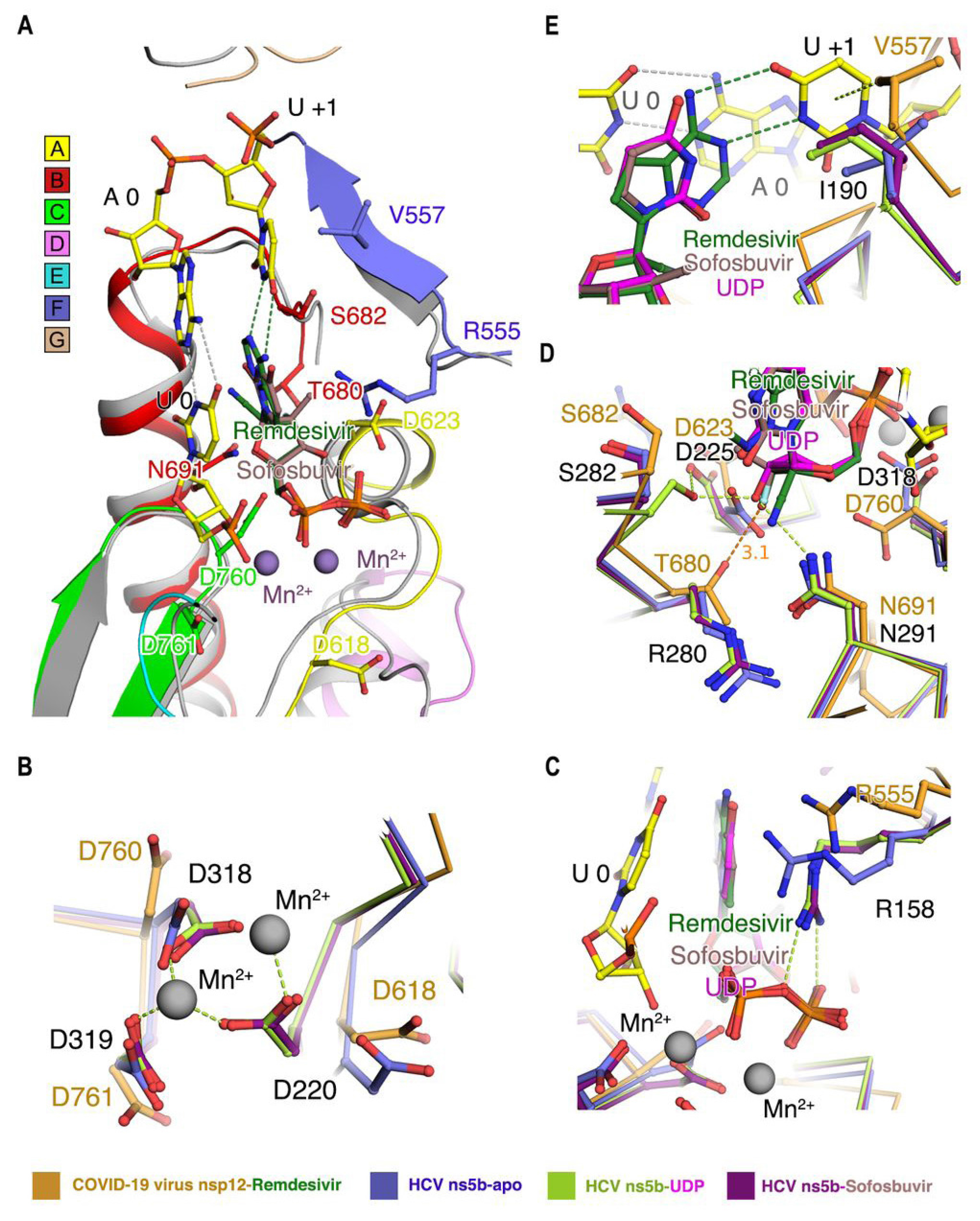
Figure: Incorporation model of remdesivir in COVID-19 virus nsp12.
(A) The polymerase motifs are colored. Superposition of the structure of HCV ns5b in complex with pp-sofosbuvir (PDB ID: 4WTG) (13) with COVID-19 virus nsp12 shows the possible positions of the two catalytic ions (brown spheres), the priming nucleotide (U 0), template strand, and the incoming pp-remdesivir in nsp12. (B to E) Structure comparison of HCV Apo ns5b or its complex with UDP and pp-sofosbuvir with the COVID-19 virus nsp12 [4].
The viral polymerase nsp12 appears to be an excellent target for new therapeutics, especially given that lead inhibitors already exist in the form of compounds such as Remdesivir. Taking into consideration that the structural similarity of nucleoside analogs with the binding mode and inhibition mechanism may have great potential to other such kind of drug candidates like Favipiravir, which has proved effective in clinical trials. Such promising drug targets such as protease could have relevance in developing a cocktail of anti-coronavirus treatments for discovering broad-spectrum antivirals. Such broad-spectrum antivirals can play a vital role in combatting the current prevailing Covid-19 pandemic globally.
References
- Jasper Fuk-Woo Chan, Shuofeng Yuan, Kin-Hang Kok, Kelvin Kai-Wang To, Hin Chu, et al. (2020) A familial cluster of pneumonia associated with the 2019 novel coronavirus indicating person-to-person transmission: a study of a family cluster. Lancet 395: 514–523. [View]
- Nanshan Chen, Min Zhou, Xuan Dong, Jieming Qu, Fengyun Gong, et al. (2020) Epidemiological and clinical characteristics of 99 cases of 2019 novel coronavirus pneumonia in Wuhan, China: A descriptive study. Lancet 395: 507–513. [View]
- Fan Wu, Su Zhao, Bin Yu, Yan-Mei Chen, Wen Wang, et al (2020) A new coronavirus associated with human respiratory disease in China. Nature 579: 265–269. [View]
- Yan Gao, Liming Yan, Yucen Huang, Fengjiang Liu, Yao Zhao, et al. (2020) Structure of the RNA-dependent RNA polymerase from COVID-19 virus. Science 368: 779–782. [View]