- 4192 Devonwood Way, Ashburn, Virginia, 20148
- Helpline: +1 (703) 665-3747
Dental Care during the Coronavirus Disease 2019 (COVID-19) Pandemic: Preventing Oral Frailty and COVID-19 Infection
- Home
- Back to Journal
- Article Details
Abstract
Aim: The COVID-19 pandemic emerged globally and has not ended in many countries. The importance of dental consultations tends to be perceived as a relatively low priority during the COVID-19 pandemic. Therefore, this brief report aims to provide an update on the risk of excessive procrastination of dental examinations.
Method: We performed a literature database searches (PubMed and J-STAGE) using the keywords “oral frailty” and “COVID-19,” combined with “older,” and “young.”
Result: Long-term lifestyle changes related to the prevention of COVID-19 transmission are either triggering or accelerating age-related diseases or frailty. Though less is known on the association between oral frailty and COVID-19 pandemic, the number of dental visits a patient makes in their lifetime is positively correlated with the number of their remaining natural teeth, and oral problems when young increase with age. Research has proven that good dental health is strongly connected to good physical and general health.
Conclusion: Dental health is an integral part of good health and longevity. Good dental health can reduce the progression of oral frailty and the risk of various infections, including viral infections. It is important to continue dental consultations properly, based on the patient’s background such as good or bad oral condition, COVID-19 epidemic status, and the existence of a high risk of progression of SARS-CoV-2 infection to severity.
Keywords: Coronavirus disease 2019 (COVID-19), Oral Health, Oral Frailty, Prevention
Introduction
The COVID-19 pandemic can lead to deterioration in oral hygiene, especially in older adults, due to the self-isolation of people in their homes and the reduction of contact with others, including their health care providers. Of course, deterioration of oral hygiene in young people can be expected, which could lead to future oral frailty. Like many medical institutions, dental institutions are striving to combat the COVID-19 infection and many changes related to the COVID-19 pandemic. The importance of dental consultations tends to be perceived as a relatively low priority, just like other lifestyle-related diseases that stem from chronic neglect, because the risk of getting infected with COVID-19 seems to outweigh the benefits of maintaining regular health appointments.
Aim and Method
There are many reports that long-term lifestyle changes related to the prevention of COVID-19 transmission (such as staying home as much as possible) are either triggering or accelerating age-related diseases and general frailty [1,2]. We believe that it is also important to pay attention to the effects of lifestyle changes on oral health during the COVID-19 pandemic. To identify the effects of these pandemic-related lifestyle changes upon dental diseases, two factors should be considered: (1) an individual’s worsening oral condition induced by refraining from undergoing regular oral exams and preventive cleanings and (2) how an individual’s deteriorating oral condition leads to an increased susceptibility to infectious diseases, including COVID-19 infection. Thus, we performed a literature database searches (PubMed and J-STAGE) using the keywords “oral frailty” and “COVID-19,” combined with “older,” and “young.”
Short Literature Review
The COVID-19 pandemic emerged globally in early 2020 and has not yet ended in many countries. In Japan, there were some announcements like “Do not go out unnecessarily” and “Avoid close contact and crowded places,” and people were afraid of getting infected when they visited medical institutions. As such, they were required to stay home unless their medical needs were urgent. In the three months, from April to June, the number of patients decreased by 12 million from the previous year [3]. In Japan, the Dental Association and the Japanese Society of Gerontology announced measures to prevent COVID-19 infection within dental clinics early in the pandemic. While referring to these guidelines, dental institutions have actively worked to prevent infection and continue offering dental services.
Do the disadvantages of visiting dental care providers outweigh the advantages? Fortunately, there was no report that the cluster of covid-19 cases occurred in a dental office in Japan, and the SARS–CoV-2 PCR positive-test rate of the dentists is the same as the average of the general population [4]. It has been reported that the number of dental visits a patient makes in their lifetime is positively correlated with the number of their remaining natural teeth [5], and that oral problems when young increase with age [6]; Therefore, it is of great importance to for patients to continue undergoing dental examinations according to their oral condition and urgency while respecting preventative measures against infection during oral examination.
Angiotensin-converting enzyme 2 (ACE2) has been established as the functional host receptor for SARS-CoV-2[7]. The oral cavity is a potential high-risk zone for SARS-CoV-2 susceptibility [8], and it is theorized that maintaining a good oral environment might help prevent COVID-19 infection. Also, oral frailty describes a condition of increased risk of respiratory infections and pneumonia [9, 10]. Thus, it is necessary to continue undergoing routine dental examinations during the pandemic, both to prevent COVID-19 infections and to prevent the onset of oral frailty at an earlier stage than it would otherwise occur; this is extremely important for healthy senescence [11].
Conclusion
Dental health is closely associated with physical and general health and is a key component of achieving and maintaining good health and longevity. Rather than recommending a systematic postponement of dental consultation, it is desirable to devise a strategy for each patient, considering whether dental problems are prevalent, the epidemic situation, and whether there is such a risk of aggravation as old age, obesity, and diabetes. We would like to highlight the importance of protecting the oral environment through the maintenance of regular dental examinations and preventative cleanings throughout the duration of the COVID-19 epidemic.
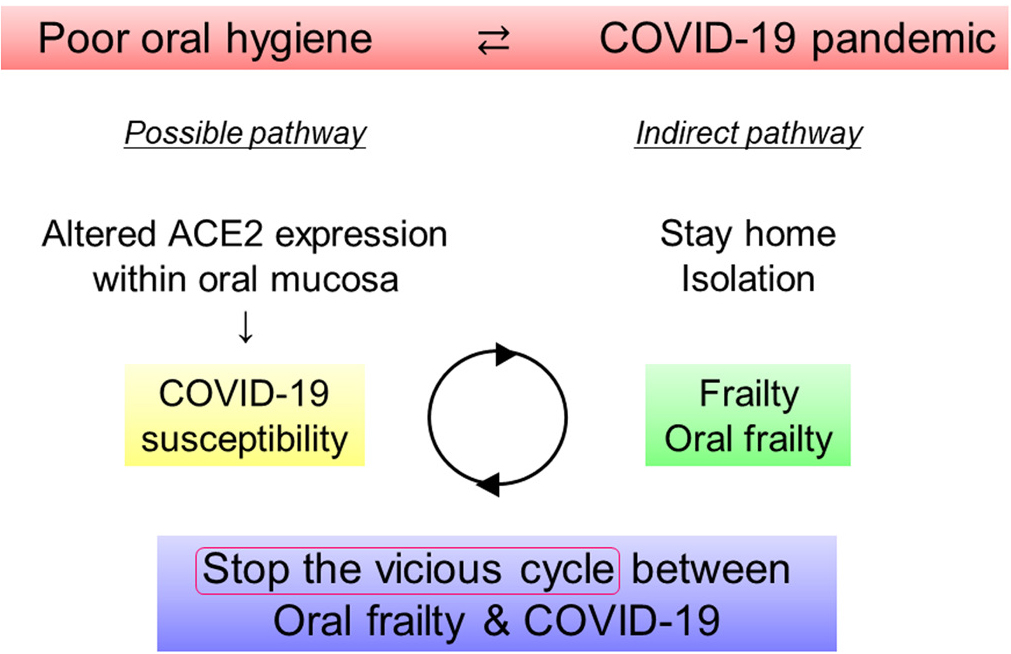
Figure 1: Oral frailty & COVID-19.
References
- Chudasama YV, Gillies CL, Zaccardi F, Coles B, Davies MJ, Seidu S, Khunti K (2020) Impact of COVID-19 on routine care for chronic diseases: A global survey of views from healthcare professionals. Diabetes & metabolic syndrome 14: 965–967. [View]
- Omura T, Araki A, Shigemoto K, Toba K (2020) Geriatric practice during and after the COVID-19 pandemic. Geriatr Gerontol Int 20: 735–737. [View]
- The Japan Health Insurance Association (2020) The Japan Health Insurance Association newspaper, September 15th, issue (in Japanese). [View]
- The Japanese society of oral health (2020) 9 Prefectural Medical Association Bulletin Questionnaire for people infected with covid-19, (in Japanese). [View]
- Saito M, Shimazaki Y, Nonoyama T, Tadokoro Y (2018) Type of dental visit and number of remaining teeth in Japanese elders. Journal of Oral Science 60: 611–617. [View]
- Broadbent JM, Thomson WM, Poulton R (2008) Trajectory patterns of dental caries experience in the permanent dentition to the fourth decade of life. Journal of dental research 87: 69–72. [View]
- Bourgonje AR, Abdulle AE, Timens W, Hillebrands JL, Navis GJ et al. (2020) Angiotensin-converting enzyme 2 (ACE2), SARS-CoV-2 and the pathophysiology of coronavirus disease 2019 (COVID-19). The Journal of pathology 251: 228–248. [View]
- Xu H, Zhong L, Deng J, Peng J, Dan H, Zeng X, Li T, Chen Q (2020) High expression of ACE2 receptor of 2019-nCoV on the epithelial cells of oral mucosa. International journal of oral science 12: 8. [View]
- Müller F (2015) Oral hygiene reduces the mortality from aspiration pneumonia in frail elders. Journal of dental research 94: 14s–16s. [View]
- Mojon P, Budtz-Jørgensen E, Michel JP, Limeback H (1997) Oral health and history of respiratory tract infection in frail institutionalised elders. Gerodontology 14: 9–16. [View]
- Morley JE (2020) Editorial: Oral Frailty. The journal of nutrition, health & aging 24: 683–684. [View]